How to Price Tickets for a Small Community Event
Price too high, and seats stay empty. Price too low, and the organizers pay the difference out of their own pockets. A little arithmetic before you announce the event avoids both.
Step 1: List every cost
Write down everything the event will cost, even small items. Split them into two groups:
- Fixed costs stay the same no matter how many people come: venue rental, sound system, stage decorations, performers, permits, printing, a photographer.
- Per-person costs grow with each guest: food, drinks, souvenirs, certificates, wristbands, shirts or race kits.
Add about 10 percent to the total for things you forgot. Every event has a few: extra ice, a broken extension cord, a last-minute tarpaulin.
Step 2: Estimate a realistic headcount
Use a number you're confident about, not the number you hope for. Look at past events, the size of your group chat or mailing list, and how many people said "maybe." For many community events, a safe estimate is around half to two-thirds of the people who say they're interested.
Step 3: Work out the break-even price
The break-even price is the lowest ticket price that covers your costs:
Break-even price = (fixed costs ÷ expected guests) + per-person cost
Example: a school concert with $600 in fixed costs (venue, sound, printing) and $2 per guest for snacks. With 200 expected guests: $600 ÷ 200 = $3, plus $2 = $5 per ticket to break even.
Now check the risk: if only 150 people come, the fixed cost per person rises to $4, so you'd need $6. If your price is $5, you'd be $150 short. Pricing slightly above break-even, say $6 or $7, protects you.
Step 4: Check what people expect to pay
Your break-even price is a floor, not the answer. Compare it with:
- what similar events in your area charge,
- what your audience can comfortably afford, and
- the value people feel they're getting: a meal, a show, a shirt, a certificate.
Round prices make cash handling easier and are simpler to remember. In many places, prices that end in 0 or 5 work best for community events.
Step 5: Use ticket types
Different prices for different people let more people come, and often raise more money overall.
- Early bird. A lower price for the first few weeks or the first 50 tickets. It brings in money early, when you need to pay deposits, and gives you a headcount sooner.
- Student, senior or child. A lower price for those who can afford less.
- VIP or supporter. A higher price with front seats, a meal or a souvenir, for people who want to give more.
- Group or family. A small discount for four or more tickets bought together.
- Free tickets. For performers' families, volunteers, guests of honor or sponsors. Count them in your per-person costs.
Keep it to three or four types. Too many choices slow buyers down.
Step 6: Watch out for fees
If you sell through a platform that charges a percentage or a fixed fee per ticket, include it in your calculations, or decide whether buyers pay it on top. On cheap tickets, a fixed fee can be a large share of the price.
Selling with direct payment, where buyers pay your own e-wallet or bank account, avoids per-ticket fees. Tixward works this way and is free for events with up to 300 paid tickets. Bigger events pay a one-time fee based on size, never a percentage of your sales. See how to sell tickets when buyers pay you directly.
Step 7: Set a deadline and a limit
Decide the last day to buy tickets, matching your caterer's final headcount date, and the maximum number of tickets based on the venue's capacity. Selling more than the venue holds is a safety problem, not just a comfort problem.
A worked example
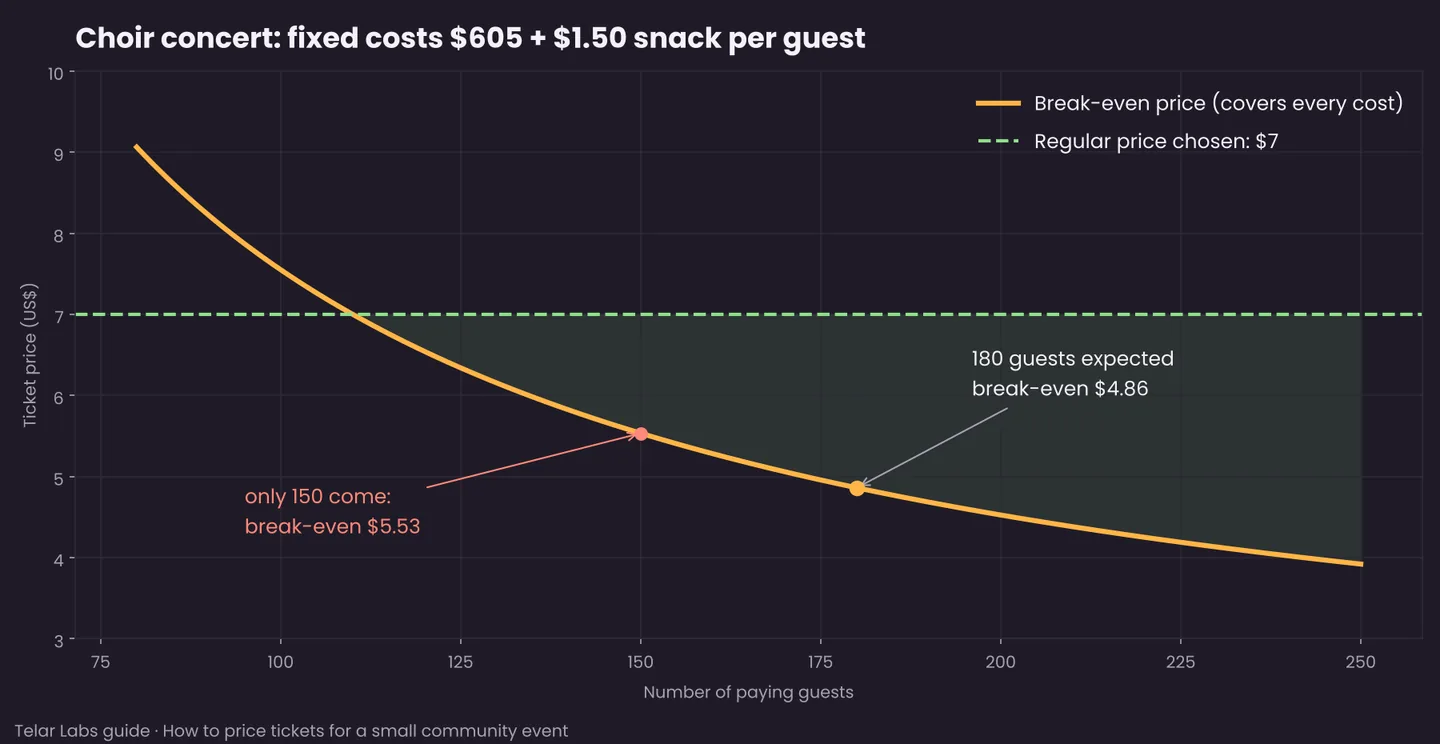
A church choir concert in a hall for 250 people:
- Fixed costs: hall $300, sound $200, printing $50, plus 10 percent buffer = $605.
- Per-person cost: a snack pack at $1.50.
- Expected guests: 180.
- Break-even: $605 ÷ 180 = $3.36, plus $1.50 = $4.86.
Their final prices: Early bird $5 (first 60 tickets), Regular $7, Student $4, and Supporter $15 with a reserved front seat. Choir members' families get one free ticket each. If 180 people come with a mix of types, the concert covers its costs and raises money for the choir's next trip.
After the event
Compare what you expected with what happened: how many came, which ticket types sold, and what you spent. Those numbers make next year's pricing much easier.
Spotted a mistake or have a tip to add? Email [email protected]. We update our guides when tools and settings change.