Grading the Writing Process in the Age of AI
When a polished essay lands on your desk, the finished text can't tell you how it was made. The process can. Looking at how students write is fairer than guessing, and it teaches them more too.
Since AI chatbots became free and easy to use, many teachers have had the same uneasy feeling: an essay that sounds too smooth, a student whose writing suddenly changed, or a paragraph that reads like a brochure. The natural reaction is to reach for an AI detector. Unfortunately, detectors are a weak basis for any decision about a student.
Why AI detectors aren't enough
AI detectors guess whether text "looks like" machine writing, based on patterns such as predictable word choices. That approach has well-known problems:
- False positives. Clear, simple, formulaic writing can be flagged, and that's exactly how many students are taught to write, especially students writing in a second language.
- Easy to fool. Asking a chatbot to "write like a 14-year-old" or running the text through a paraphrasing tool often changes the result.
- No explanation. A percentage score doesn't show what happened, so it's hard to discuss with a student or a parent.
Even the companies that build detectors usually say their scores should not be used as the only evidence. A student accused unfairly loses trust in you and in writing itself. So it's worth shifting the question from "Does this text look like AI?" to "How did this text come to be?"
Five ways to see the process
1. Ask for the stages, not just the result
Break a writing task into parts that are handed in separately: a topic and three questions, an outline, a first draft, and a final draft with a short note on what changed. Each stage takes only a few minutes to check, and a student who has done the thinking will have something to show at every step. It also simply makes the writing better.
2. Write some of it in class
Even 20 minutes of in-class writing gives you a sample of each student's natural voice. Keep these samples. When a later essay looks very different, you have something real to compare it with, and a starting point for a conversation.
3. Use version history
If students write in Google Docs or Microsoft Word online, the version history shows how the document grew over time. Large blocks of text that appear all at once, without any typing before them, are worth asking about. Version history has limits, though: it shows snapshots, not every keystroke, and students can write elsewhere and paste the result in.
4. Record the writing itself
A writing recorder captures each keystroke, pause, deletion and paste inside the editor, with timestamps, so you can replay how the essay was written. Our free tool DraftTrail works this way. Students write in DraftTrail, download a small .drafttrail file and hand it in, for example as an attachment in Google Classroom. You open the files in your browser and see a timeline, a replay and plain-language flags for things like big pastes, very few corrections, unusual speed or lots of time away from the page.
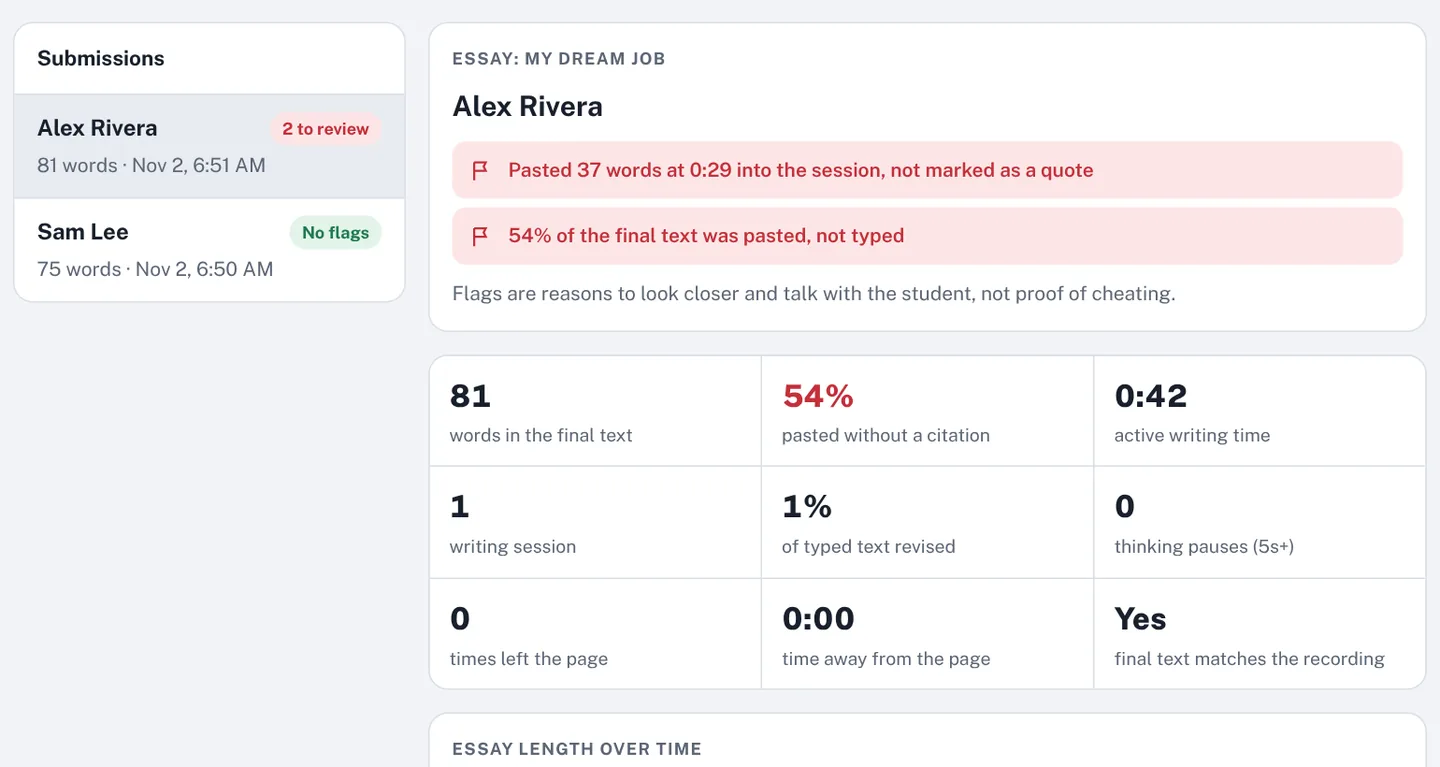
DraftTrail doesn't claim to detect AI, and that's on purpose. It shows how the text arrived: typed with pauses and corrections, or pasted in large blocks. Nothing is uploaded to us; the recording stays on the student's device until they hand in the file.
5. Talk with the student
The most reliable check is still a short conversation. Ask the student to explain their main argument, why they chose a particular example, or what a sentence means. Students who wrote their own work can usually talk about it easily, even if they're nervous. Keep the tone curious, not accusing.
Reading process signals fairly
Process data needs the same care as any other evidence. A few things that look suspicious often aren't:
- Pasting a quote from a source is normal. DraftTrail asks students whether pasted text is a quote and adds the citation, so you see it as a cited quote instead of copied text.
- Writing in another app first, such as a phone's notes app on the bus, and pasting it in later. Ask to see the original notes.
- Very fast, clean typing can simply mean a confident typist who planned carefully.
- Long pauses are usually thinking, reading or a younger sibling asking for help.
Treat a flag as a question to ask, never as proof. The goal is to understand what happened, then help the student do the work properly next time.
Make it part of your class culture
Students respond better to process checks when they're explained up front and applied to everyone, not just to students under suspicion. Tell your class at the start of the term:
- "I grade the process as well as the final essay."
- "You'll hand in your outline and drafts, and I may ask you to talk me through your work."
- "AI tools are allowed for these parts of the task, and not for these." Be specific: brainstorming ideas might be fine, while writing paragraphs is not.
Giving a few points for the process itself, like a good outline or a meaningful revision, also tells students that the thinking matters, not just the final product.
A simple plan for your next essay
- Set the task with clear rules on what help is allowed.
- Collect a short outline in class.
- Have students write the draft in a tool that records the process, or at least in a document with version history.
- Read the process alongside the essay, and note anything you want to ask about.
- Have a two-minute conversation with any student whose process raises questions.
It takes a little more time at first, but it replaces a guessing game with something you can actually see and discuss. For quizzes rather than essays, see How to reduce cheating in online quizzes.
Spotted a mistake or have a tip to add? Email [email protected]. We update our guides when tools and settings change.